Farm shops & honesty boxes: why an open cash tin is a security risk
Farm shops are booming. Direct sales, regional sourcing, short routes from field to plate – demand for honest food straight from the producer has been rising for years. What rarely gets discussed: in hardly any other retail model does cash sit out as exposed as in the classic unattended farm shop with an honesty box.
An open cash tin on a wooden table, a handwritten price list, a note saying "Please pay the exact amount" – that isn't a security concept. That's an open invitation.
Why farm shops carry a particular risk
The honesty box works because most people are honest. But it doesn't always work. And the conditions in farm shops make it especially easy for opportunistic thieves and organised gangs alike.
Most farm shops aren't continuously staffed. Self-service formats in particular – converted barns, sheds or wooden roadside huts – run for hours or even the entire day without personnel on site. The till sits in plain view, often without CCTV. The nearest neighbour might be 200 metres away, the nearest police station a 20-minute drive.
Add seasonal peaks. During strawberry season, asparagus season, the run-up to Christmas – when a farm shop is busy, three-figure cash sums build up in the open tin quickly. On a strong Saturday in December, £300, £400 or £500 can sit in an unsecured metal box. Word gets around.
And finally, there is almost never a four-eyes principle. No shift handover, no cash-up with countersignature, no separation between the act of selling and access to the money. Whoever takes cash – customer, staff member or stranger – cannot be traced after the fact.
What an open cash tin actually means
An honesty box without physical protection has three structural weaknesses that no sign and no goodwill can offset.
First: full access. Anyone entering the shop has unrestricted access to the entire cash holding. Not just to what they themselves dropped in, but to everything that has accumulated since the last collection. That is a fundamental difference from a deposit system, where money is no longer reachable once it has been deposited.
Second: no protection against manipulation. Change-giving tricks, fake change, a quick reach into the tin during payment – an open box offers zero barrier against everyday petty crime. Losses build up over weeks and months without ever showing up as a single incident.
Third: no protection against burglary. A metal tin can be prised open in seconds or simply lifted and carried away. At night, on weekends or through the winter, when the shop is closed and nobody is nearby, the cash tin is the easiest target on the entire site.
How a deposit safe makes the honesty model viable in the first place
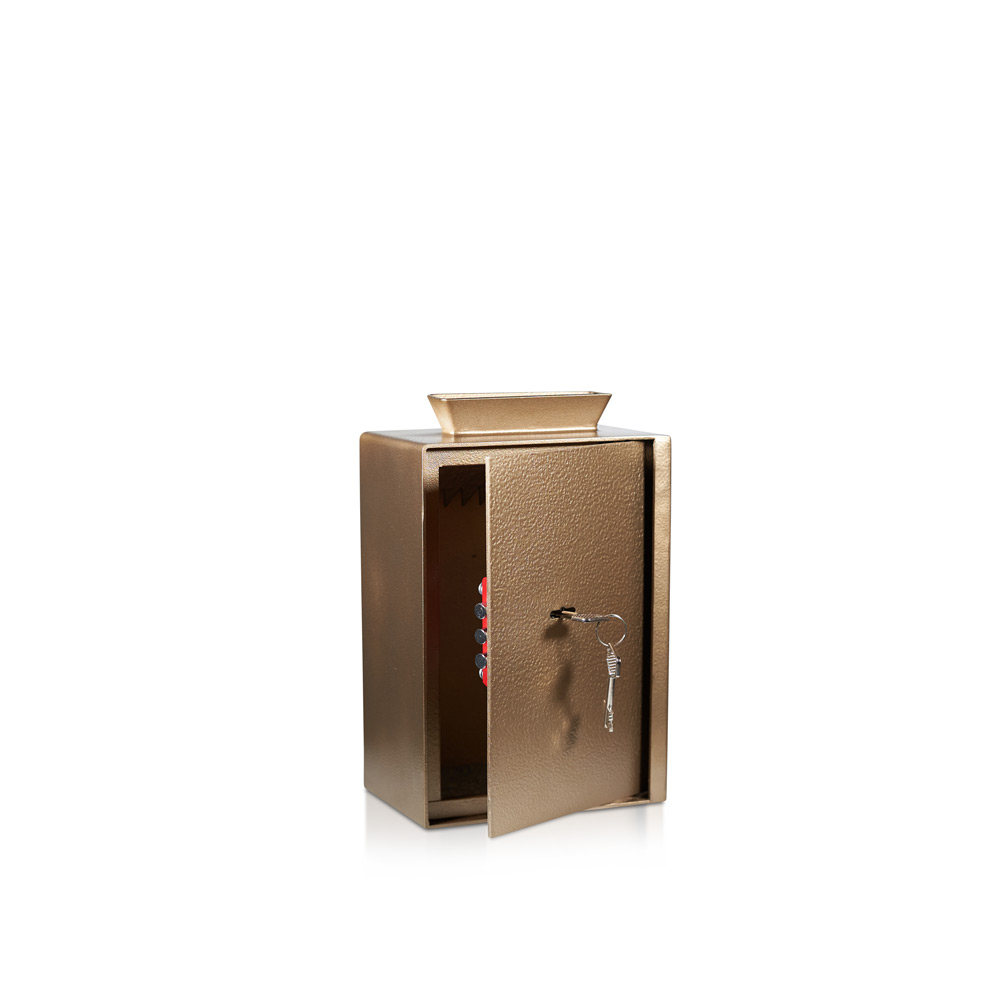
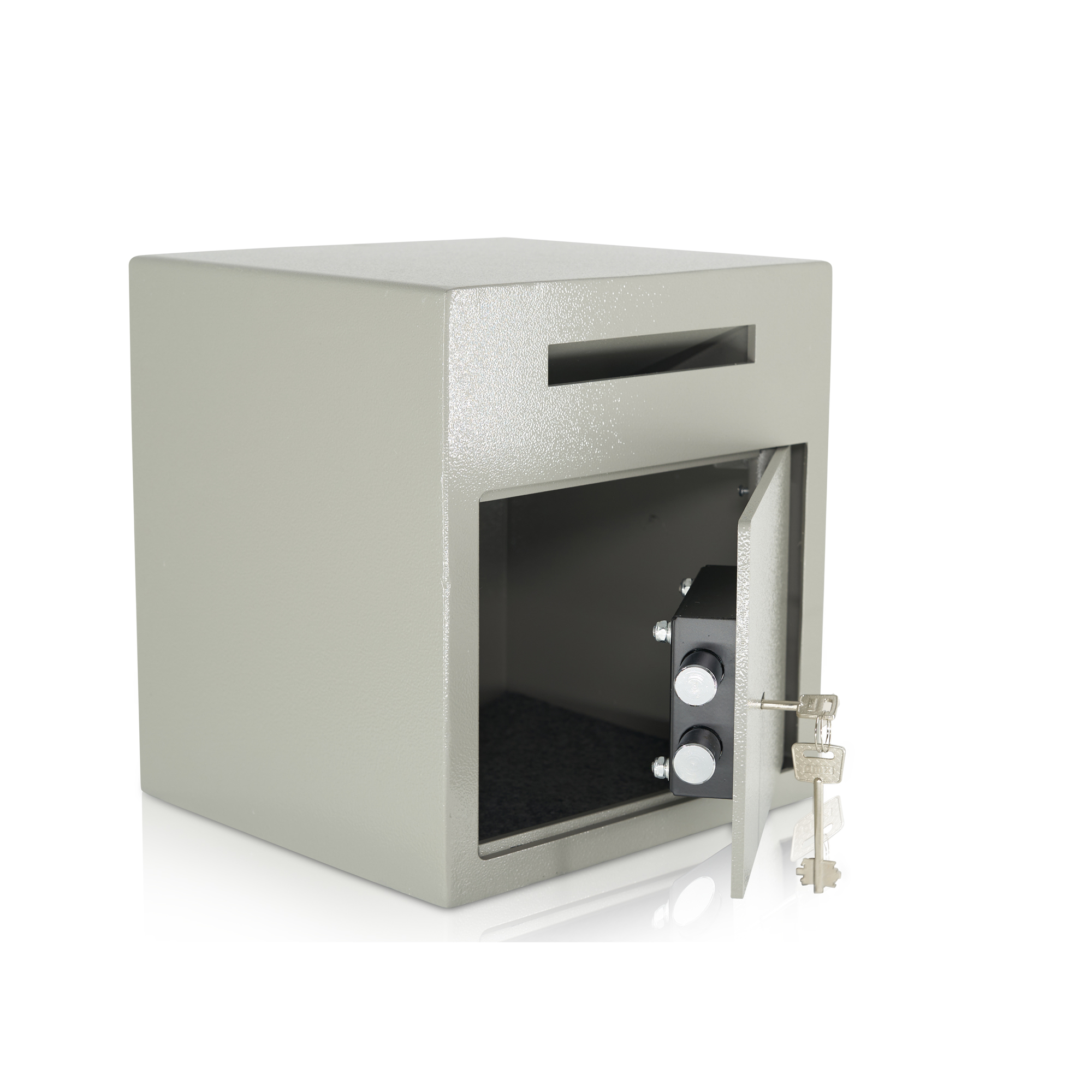
A deposit safe doesn't replace the honesty box – it gives it the security foundation it lacks. The principle stays the same: the customer pays independently, with no staff and no supervision. But the moment the money goes in, it disappears behind steel.
With a deposit safe with throw-in slot, banknotes and envelopes are dropped through a narrow slot. Reaching back in is structurally impossible. The slot is dimensioned so that notes and folded receipts pass through, while a hand cannot.
For farm shops where coins, change pouches or small envelopes with order slips also need to go in, a deposit safe with drop-down flap is the better fit. The flap opens inward and falls back under its own weight – fishing the contents out without a key isn't possible.
Either way: from the moment of deposit, the cash is secure. It isn't the shop owner who protects the takings – the safe does. Twenty-four hours a day, seven days a week, even when nobody is on the farm.
Installation in a farm shop – what matters
Farm shops aren't office spaces. They sit in converted stables, barns, garages or freestanding wooden huts. That places specific demands on installation and anchoring.
Subfloor: Many farm shops have concrete floors – ideal for anchoring with heavy-duty bolts. On wooden floors or paving, a steel base plate has to bridge the gap. Anchoring is critical for lighter safes in unattended rooms in particular: without a fixed connection to the floor, a compact safe can be removed in minutes.
Placement: The safe should be intuitively reachable for every customer – ideally next to the price list or the goods shelf. At the same time, it shouldn't sit right next to the entrance, where it would be within reach in passing, but rather a step further inside the room.
Signage: A simple "Please drop payment here" is enough. Customers familiar with the honesty-box principle understand a deposit safe immediately. It doesn't come across as defensive but as professional – a signal that the operator takes the business seriously.
Climate and humidity: Uninsulated barns and wooden huts get cold and damp in winter. Quality deposit safes in powder-coated steel are built for that. Electronic locks generally cope with cold but shouldn't be exposed to permanent condensation. In persistently damp environments, a mechanical key lock is the more reliable choice.
The numbers: when does a deposit safe pay off?
The honest answer: from day one. But for anyone who needs figures to justify the investment, it's straightforward to work out.
A well-frequented self-service farm shop typically takes £80 to £150 in cash on a normal day. On Saturdays, in season, or in the run-up to a holiday, £300 and more isn't unusual. Per week, £600 to £1,000 quickly run through the open till.
If just five per cent of that is lost to shrinkage, hands in the till or a single theft, that's £30 to £50 a week. Over a year, the figure adds up to £1,500 to £2,500 – several times the cost of a deposit safe.
And that's before counting a single break-in. One night-time burglary with the cash tin taken can cost an entire day's takings plus repair costs to a door or window. In that case, the deposit safe pays for itself in a single evening.
What the deposit safe doesn't need to be
Farm shops don't need a certified high-security safe. There's no jeweller's stock in six-figure territory. Cash sums sit in the lower three-figure range, rarely above. What's needed is a robust, everyday-grade safe that does three things reliably: take in cash, prevent access, and resist a forced-entry attempt long enough that the effort isn't worth it for the offender.
That's exactly what deposit safes are built for. Steel body, locking bolt mechanism, tamper-resistant deposit system – at a price proportionate to the value being protected.
Seasonal trade and emptying
Takings rise in high summer and before Christmas, drop in January and February. The basic principle stays the same; only the emptying rhythm shifts.
In peak season, daily emptying is the right call – ideally in the evening once the last customer has left. In quieter months, every two or three days is usually enough. The point is: even with less frequent collection, the cash stays secure inside the safe. There's no time pressure as there would be with an open box that has to be emptied "quickly before someone takes it".
For operations running multiple farm shops or sales points – say, on weekly markets and at the farm in parallel – emptying routines can be standardised. One key, one responsible person, a fixed cadence. That brings structure to a business model that otherwise leans heavily on trust and improvisation.
Bottom line
Farm shops thrive on trust. That trust deserves a security foundation that isn't built from sheet metal and good intentions. A deposit safe protects takings from the moment of deposit – round the clock, without staff, without compromise.
All DiaDorn deposit safes are compact enough for the smallest farm shop and robust enough for the toughest barn floor. For questions on the right size, lock type or anchoring for your location, our team will be happy to advise you in person.